The Fitting Room at Altitude: A Mayfair-to-Cotswolds Shopping Day by Air
Photo: Nigel Mykura, CC BY-SA 2.0, via Wikimedia Commons
Retail, at its most agreeable, is not a transaction but a sequence of small ceremonies: the door held open before the hour, the chair placed just so, the assistant who has already set aside the size you did not know you needed. What spoils it is rarely the shops themselves. It is the driving — the slow grind out of Mayfair, the roadworks at Burford, the search for a parking space that costs more than the shirt.
A helicopter does not remove that friction so much as relocate it. It converts a day of two halves into a single, continuous loop, and it does so with a punctuality that no chauffeur-driven saloon can promise on a Friday. What follows is a template for the well-choreographed retail day, written for the traveller who regards shopping as an appointment diary rather than an errand.
Designing the Day Backwards
The error most often made is to begin with the aircraft. Better to begin with the opening hours and work inwards. Bond Street's great houses open at ten; the private preview, arranged in advance, begins at half past nine, when the vitrines are still being polished and the street outside is quiet. Tetbury's antiques dealers, by contrast, keep civilised hours and are at their most accommodating after two. Between those two fixed points sits lunch.
Once the diary is settled, the aircraft follows. A light twin such as an Airbus H135 or an AW109 will comfortably carry four passengers with hand luggage, cruise at around 130 knots and, crucially, hold enough fuel for a discretionary diversion should the weather over the Cotswold escarpment prove less obliging than forecast.
Nine O'Clock on Mount Street
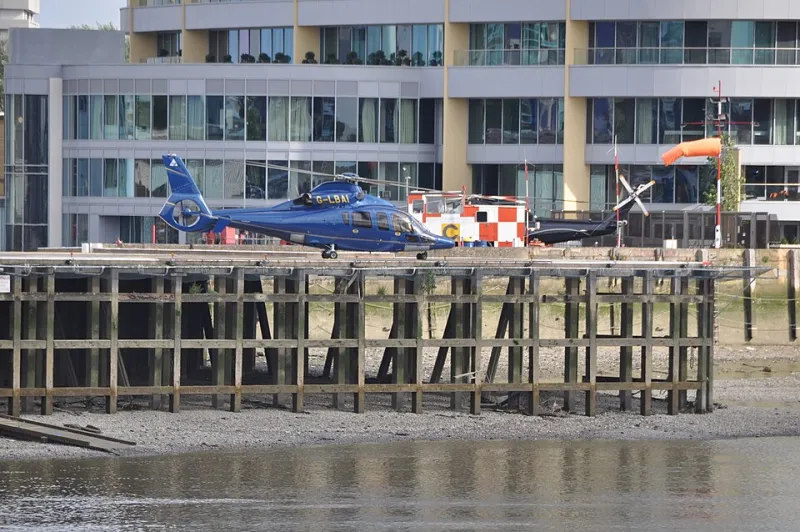
The London Heliport at Battersea is the capital's only licensed heliport, and it is where any sensible Mayfair itinerary begins. A departure from a home county at a quarter past eight delivers you to Battersea by ten to nine; a pre-booked car covers the mile and a half to Mount Street in twelve minutes at that hour. The helicopter has done the long work — the M4, the Chiswick flyover, the King's Road — leaving only the last mile, which is precisely the mile best left to a car.
Book the appointment as a private preview rather than a standard fitting. Houses on Bond Street, Mount Street and Bruton Street will routinely open early for a known client, lay on a fitting room and hold stock in advance. Arrive with a list, not an inclination.
The Midday Pivot
By half past twelve you will have exhausted the morning's goodwill, and it is time to leave before London becomes interesting. Return to Battersea for a twenty past twelve departure and the Cotswolds are thirty-five to forty minutes away — a distance that would otherwise consume two hours of the day and most of your patience.
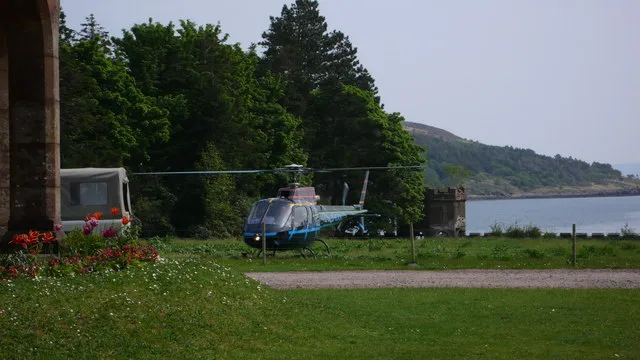
Landing is the part that rewards forethought. Kemble, the former RAF station now trading as Cotswold Airport, is the pragmatic choice for the southern Cotswolds: licensed, familiar with rotary traffic, and requiring prior permission. Estate and farm landings are possible and often more elegant — a lawn below the house, a mown strip beyond the ha-ha — but they depend on written consent from the landowner, a site survey, and a courtesy call to the parish. Noise-sensitive villages deserve particular care, and the operator will advise on routings that avoid the most conspicuous approaches.
Lunch, Then the Cluster
A country lunch should not be rushed, but nor should it be indulged to the point of torpor. A table at Barnsley House, Thyme at Southrop or the Rectory at Crudwell will serve admirably, each within a short drive of the principal antiques clusters.
Tetbury is the anchor. Long Street and its neighbouring lanes hold a concentration of dealers in furniture, silver, prints and the sort of English pictures that never quite make the auction rooms. Stow-on-the-Wold and Burford offer alternatives, and Daylesford — for the more domestic sort of acquisition — sits conveniently to the north. A word to each dealer in advance will ensure that the pieces you have seen online are out of the window and under proper light when you arrive.
What Travels and What Follows
The hold of a light twin is generous by car standards and modest by removal-van standards: roughly a cubic metre and a half, with a weight allowance that must be shared with the passengers. Suitcases, hat boxes and garment bags are straightforward. A pair of side chairs, a crate of glass or a marble-topped console are not.
For anything of size, the civilised arrangement is a bonded courier. Most dealers will pack and dispatch within the week; some will hold pieces until a consolidated delivery can be arranged. Insist on transit insurance, keep every receipt together in a single folder, and photograph condition before wrapping — a discipline that costs nothing and settles arguments.
Liquids, aerosols and the like are not subject to commercial security screening on a private charter, but operator rules still apply, and fragile items should be carried in the cabin where they can be watched.
The Light and the Return
From November, the calculation changes. Sunset in mid-November falls shortly after four, which means a late-afternoon departure from the Cotswolds is flown in darkness. That is entirely routine for a twin-engine aircraft with a night-rated crew and instrument approval, but it should be planned rather than discovered. Either bring the departure forward to half past three, or accept a night leg and enjoy it — the westward glow over the Thames basin is a considerable consolation.
Landing back at Battersea at a quarter past five puts you in the car before the evening crush has properly formed, and home before seven. That, in the end, is the quiet luxury on offer: not that the day was faster, but that it was whole — fittings, lunch, a pair of chairs and a conversation with a dealer, all completed without a single hour surrendered to a dual carriageway.
The day ends as it began, with a door held open. The difference is that everything behind it has already been arranged.