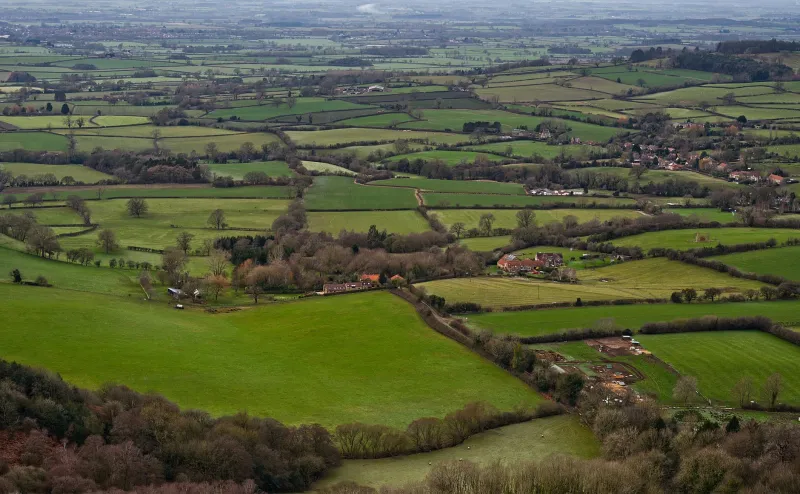
Frost on the Parterre: A Winter Garden Day by Air

Photo: Unknown authorUnknown author, Public domain, via Wikimedia Commons
There is a particular hour in a British winter garden when the light arrives low and almost horizontal, and the frost sits on the gravel like a held breath. The herbaceous borders are gone. What remains is structure: the pale architecture of birch, the iron ribs of a glasshouse, the geometry of box and yew. It is a season that rewards the airborne visitor, not least because the crowds have gone and the garden is returned, briefly, to those who notice such things.
The Case for the Cold Season
Winter is not the florist's season; it is the architect's. A parterre read from the air becomes a drawing, its pattern legible when the planting is not. Avenues show their bones. A lake, unruffled and cold, doubles the sky. For a charter party of two to four, the appeal is partly sensory and partly practical: shorter queues, quieter paths, and the unmistakable warmth of stepping from a frosted terrace into a heated Victorian glasshouse, where the air smells of damp earth, citrus peel and coal-smoke history.
The constraints are equally real. Daylight is scarce, and a December afternoon in England offers little more than six usable hours. A winter itinerary should therefore be modest in ambition: two ground stops, perhaps three if they are close and brief, with an early departure and a firm intention to be on the ground before the light goes flat.
A Route of Three Temperaments
The most satisfying cold-season day tends to combine three distinct garden characters. First, an arboretum, where the subject is tree structure and bark. Second, a historic glasshouse, where the subject is warmth, engineering and the improbable survival of the exotic. Third, a country-house garden, where the subject is geometry under frost.
For illustration, a western route might pair the National Arboretum at Westonbirt with a private estate glasshouse in Gloucestershire and the formal terraces of a Somerset house. An eastern route could set a private arboretum in Essex against the great glasshouses of a Victorian plant collection and the parterres of a Hertfordshire estate. The particular names matter less than the rhythm: cold, warm, cold again, with the helicopter as the thread between them.
Skeleton and Silhouette
An arboretum in winter is an exercise in line. Without leaf, the eye follows branch and trunk: the white stem of a Himalayan birch, the peeling cinnamon of a paperbark maple, the dense evergreen mass of a holly. Frost exaggerates the effect, outlining every twig. Where a summer visit offers colour, a winter visit offers drawing.
Ground time should be generous enough for a slow walk rather than a circuit. Ninety minutes is usually sufficient for a focused collection, and a wheelchair-accessible path or a driven route can extend the range for guests who prefer not to walk far in the cold. Sensible footwear matters more than elegance here; the helicopter can carry a change of shoes, but not a change of weather.
The Warmth of the Glass
A Victorian glasshouse is the emotional centre of a winter garden day. The contrast is the point: outside, a hard frost; inside, humidity, scent and the surprising scale of palms and tree ferns. Architecturally, these buildings are among the most confident structures Britain ever built, their ironwork designed to admit the maximum of low winter light.
For the photographer, winter is arguably the best season indoors: the sun is low, the shadows long, and the glass does not glare as it does in June. For everyone else, the pleasure is simpler — a bench, a camellia in flower, and the sense of having stepped into a warmer climate without leaving the country. Check glasshouse closing times carefully; several close earlier than the wider garden in winter, and some open only at weekends.
Geometry Under Frost
A country-house garden in winter is best understood from above and then on foot. From the air, the parterre reads as a plan: squares of gravel, rectangles of turf, the dark punctuation of yew. On the ground, the same garden becomes a series of framed views, with statues and urns standing in for summer's flowers.
Frost improves the effect. It picks out the edges of hedges and the ridges of gravel, and it lends a temporary austerity to gardens that can feel over-furnished in July. A short guided walk, followed by a hot drink in an estate café or an orangery, is often the right proportion.
Permissions, Hours and the Practical Frost
Landing in or beside a garden is never a casual matter. Permission must come from the landowner, and the aircraft must operate within Civil Aviation Authority rules and the site's own conditions. Many estates have an established private helipad or a hardstanding used for events; others can accept a landing only on a farm strip or an adjacent field, and winter ground conditions may rule out soft grass entirely. Frost, standing water and livestock all argue for a hard surface and a prior site visit or at least a detailed conversation with the estate office.
Expect landing fees, prior permission requirements and noise-abatement instructions. Winter is often a better time for estate staff to accommodate a visit, but it is also a time of reduced opening hours: many gardens open at ten and close at four, with last entry earlier. Build in a buffer for weather, and consider an overnight stay at a country-house hotel if the itinerary includes a third stop. A reputable operator will handle permissions, fuel, de-icing and weather minima; the passenger's task is to be clear about ground times and to travel light.
A Considered Itinerary
A workable winter day might begin with a 9am departure from a licensed airfield, a 25-minute flight to an estate strip, and a 90-minute arboretum walk. A short hop to a nearby estate follows, with lunch in a converted orangery and an hour in the glasshouse. The final leg — a country-house parterre — can be brief, perhaps 45 minutes, before a return flight that lands well before dusk. The pace is deliberately unhurried. The point is not to collect gardens but to inhabit them.
The Quiet Luxury of Absence
What winter offers, above all, is absence: of coaches, of queues, of the pressure to admire. A garden in January belongs to the birds and the gardeners, and to the small party who arrive by air. Seen from a low hover over a frosted parterre, or from a bench inside a glasshouse with the light coming through iron and glass, the British garden reveals a colder, quieter and more architectural self. It is a distinctly civilised way to spend a short day.