Pale Heights: A Helicopter Itinerary for Britain's First Snow
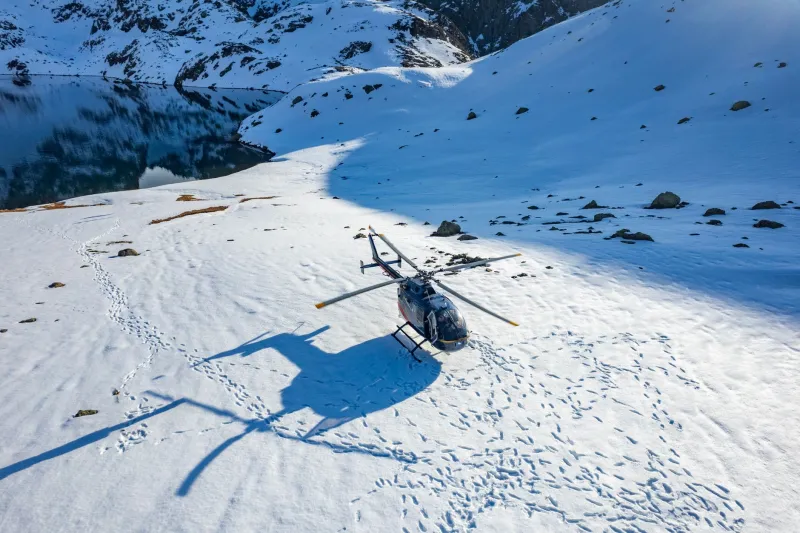
There is a particular week in late November or early December when the forecast charts turn a deeper blue, the freezing level drops below the summits, and Britain briefly acquires the aspect of somewhere considerably more dramatic. In 2026 that week will arrive, as it always does, without much ceremony. The snow will settle first on the high ground of the Pennines, then on the Lakeland fells, and finally — most reliably of all — on the Cairngorm plateau, where it will remain until spring.
For the traveller who values both the view and the arrival, this is the most rewarding season of the charter calendar. Roads close, passes become marginal, and the A93 above Spittal of Glenshee acquires the habit of shutting for days at a time. The helicopter does not.
Reading the Forecast Before Committing
A winter scenic charter is a negotiation with the weather, and the sensible starting point is not a route but a conversation about flexibility. Most UK operators fly under visual flight rules, which means cloud base, visibility and surface wind matter more than temperature. A low freezing level is welcome; a low cloud base is not.
The practical approach is to hold two dates rather than one, ideally within the same week, and to agree in advance how a weather cancellation will be handled — whether the deposit transfers, whether a shorter local flight can be substituted, and how much notice the operator requires. Reputable charter brokers will build this into the quotation rather than treating it as an afterthought.
Watch the Met Office mountain forecasts for the Pennines, the Lake District and the Cairngorms in the fortnight before travel. The phrase to look for is not "snow" but "snow lying" — a distinction that separates a picturesque dusting from a landscape genuinely transformed.
The Pennine Edge
A northern departure from the home counties brings the aircraft onto the Pennine spine within forty minutes. The route north of Manchester is where the season announces itself: the moorland above the Snake and Woodhead passes holds snow long after the valleys have lost it, and the north-facing gullies of Kinder Scout and Bleaklow retain a thin white script of drainage lines that reads beautifully from altitude.
Landing in this country requires prior permission and a good deal of it. There are estates above the Derwent Valley and in the Yorkshire Dales that will host a helicopter by arrangement, usually in exchange for a lunch booking or a modest landing fee, but nothing should be assumed. The Three Peaks — Ingleborough, Whernside and Pen-y-ghent — are best seen from the air rather than from beneath a rotor, their summits offering a clean, cold panorama in the low winter sun.
Lakeland, Where the Snow Sits Low
The Lake District is where the first snows become genuinely theatrical, because the snow line falls further here than anywhere in England. At 1,200 feet one flies level with ground that would otherwise require crampons: the arête of Striding Edge, the great northern cirque of Great Gable, the long white shoulder of Helvellyn.
A well-planned day will cross the Kirkstone Pass, follow Ullswater to its head, and land at one of the country house hotels that have grown accustomed to the sound of rotors — several near Ambleside, Grasmere and the northern lakes offer landing arrangements for dining guests. A fireside lunch of Herdwick lamb while the fells sit white beyond the window is, in the editor's view, the most civilised possible conclusion to a morning at altitude.
Landing on National Trust land is not permitted without express consent, and the open fells are more restricted than they appear from above. This is a matter for the operator, who will hold the relevant permissions and land only where the landowner has agreed.
The Cairngorms, Where the Season Lasts
The Cairngorm plateau is the real prize and the reason many travellers make the journey north at all. Snow here is not a passing spectacle but a resident: the high corries hold their cover through the worst of the winter, and the views from above Braemar toward Ben Macdui and Cairn Toul are as close to Arctic Canada as these islands offer.
The A93 through Glenshee is frequently closed by drifting snow in December, which is precisely the moment the helicopter justifies itself. A flight from Edinburgh or Perth reaches Braemar in around forty minutes; the Fife Arms, with its roaring fires and its remarkable collection of Scottish art, is an obvious anchor for lunch. Farther west, the Torridon offers a similar proposition on a more elemental stretch of coast.
Winter operations at this latitude demand respect. Daylight is short — sunset in Braemar in late December arrives before four o'clock — and aircraft performance falls with density altitude. Operators flying here in winter will build generous margins into the day, and passengers should expect an earlier departure than the summer equivalent.
Photography from Twelve Hundred Feet
The photographic appeal of a snow-covered Britain lies in its contrasts: dark forestry against white moorland, the black ribbon of a reservoir against its frosted shores, the line of a drystone wall picked out like a pencil sketch. The light is low and long, and the best hours are narrow — roughly from an hour after sunrise to mid-morning, and again from two o'clock until the light goes.
Metering is the principal difficulty. Snow reads as grey to a camera, so an exposure compensation of around plus two-thirds of a stop is a reasonable starting point, with the histogram as the final arbiter. A fast shutter speed is essential; at 120 knots and 1,200 feet, a 1/1000th setting reduces the smear of foreground detail to something acceptable. Ask the pilot to fly a gentle orbit rather than a straight pass — the difference in usable frames is considerable.
Cold-Weather Operations and Comfort
A properly winterised charter aircraft will arrive warm, with the cabin heated before boarding and the airframe cleared of any contamination. De-icing and anti-icing procedures add time to the start of a day, and it is wise to allow for it rather than to schedule the first landing too tightly.
Passengers should dress for the landing rather than the flight. Snow-covered ground demands proper boots, and a landing site on an estate track or a frost-hardened lawn is no place for thin soles. Gloves, a hat and a windproof outer layer are not indulgences in a Cairngorm December.
Booking at Short Notice
Paradoxically, the first snows are best pursued with a degree of spontaneity. Operators frequently have positioning flights and empty legs in the shoulder weeks before Christmas, and a party willing to travel at seventy-two hours' notice can often secure favourable terms. The trade-off is the weather itself: short-notice booking and weather-flexible chartering are two halves of the same discipline.
For a group of four to six, a light twin or a single-engine turbine will manage the Pennines and the Lakes comfortably; the Cairngorms leg is better served by something with more range and more power in reserve. The right answer depends on the route, and the route depends on the forecast — which is why the conversation should begin with the operator, and not with the itinerary.