A Winter Trio by Air: Bath, York and Winchester in a Single Festive Day
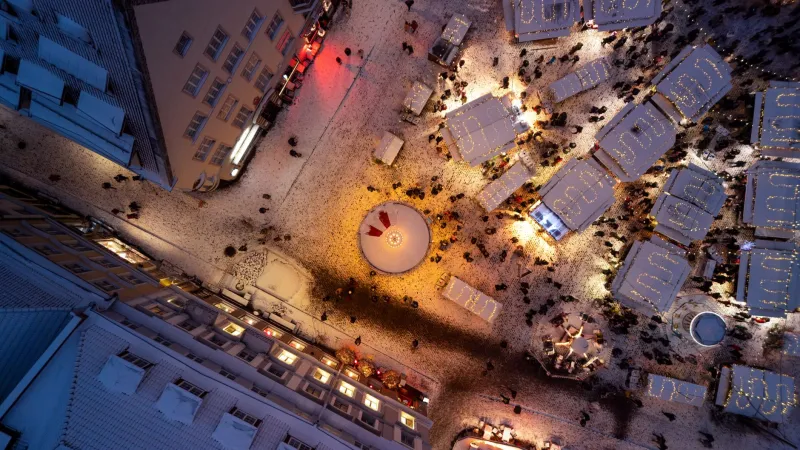
As December approaches, the temptation is to default to the capital. The Regent Street lights are undeniably theatrical, and the South Bank has its own chilly charm, but the crush can overwhelm the pleasure. For travellers who prefer atmosphere to crowd, the regional Christmas market is a more rewarding proposition — and the helicopter turns three separate excursions into one coherent winter day.
The circuit below is deliberately disciplined. It is not an attempt to “do” three cities in the manner of a coach tour. It is a measured sequence of short visits, each with a reserved lunch, a glass of something warm and enough time to make a purchase or two without sprinting back to the aircraft. The reward is a day of stone streets, cathedral bells and winter light, with the capital’s congestion left far below.
The Case for a Regional Circuit
Bath, York and Winchester are not interchangeable. Bath offers honey-coloured Georgian streets and a market that spills through the abbey quarter. York brings the minster, half-timbered lanes and the particular glow of St Nicholas Fair. Winchester is quieter and more ecclesiastical, its cathedral market arranged around the close and the scent of mulled wine drifting between the stalls.
By air, the distances collapse. What would be a tiring sequence of rail changes and taxi transfers becomes a series of 35- to 75-minute hops. The caveat is that a three-stop day demands punctuality. The pilot will build in weather and air-traffic buffers, but passengers should treat the timetable as a firm framework rather than a loose suggestion.
A Realistic Timetable for 2026
The following timings assume a private charter departing from a London-area heliport or airfield, subject to the published 2026 market dates and daylight. Flying times are approximate and will be confirmed by the operator.
| Time | Movement |
|---|---|
| 06:45 | Depart London area by helicopter |
| 08:00 | Arrive York; chauffeured transfer to St Nicholas Fair |
| 08:15–10:00 | Market browsing; coffee and a first mulled wine |
| 10:15 | Depart York |
| 11:35 | Arrive Bath; transfer to the market quarter |
| 11:50–13:45 | Bath Christmas Market; reserved lunch at 12:30 |
| 13:50 | Depart Bath |
| 14:25 | Arrive Winchester; transfer to the cathedral close |
| 14:35–15:25 | Winchester Cathedral Christmas Market; final purchases |
| 15:30 | Depart Winchester |
| 15:55 | Land in the London area as the last winter light holds |
The order matters. York is best encountered early, before the day-trippers arrive and while the minster still dominates a relatively quiet skyline. Bath then provides the natural lunch stop, with its market dense enough for a short visit but not so sprawling that an hour and three-quarters feels rushed. Winchester, closest to London, makes an elegant final call before the return leg.
Landing Arrangements and Ground Transfers
City-centre landings are not assumed. In each case the operator will secure prior permission, coordinate with local authorities and observe noise-abatement requirements. Bath, York and Winchester all require a short chauffeured transfer from a licensed landing site or nearby airfield; passengers should expect 15 to 25 minutes on the ground rather than a walk from the rotor.
This is not a drawback. The transfer is part of the day’s rhythm, and a pre-arranged car removes the uncertainty of taxi queues. Passengers should carry photo identification for the manifest and keep outer layers accessible, since the aircraft cabin may be warm while the market streets are not.
A Sensible Luggage and Purchases Plan
Helicopter travel rewards restraint. Weight and balance are calculated precisely, and baggage space is more limited than on a scheduled flight. Passengers should bring soft holdalls rather than rigid suitcases, declare any larger items in advance and avoid overpacking for a single day.
Market purchases require their own discipline. A collapsible holdall is useful for wreaths, ceramics and wrapped bottles, but glass should be padded and kept secure in the cabin rather than consigned loosely to a hold. Larger items — a framed print, a case of wine, an ambitious Christmas tree decoration — are better sent home by courier. The operator can advise on suitable arrangements, and keeping receipts will simplify any onward shipping.
Mulled wine is part of the ritual, but moderation is the civilised approach. The pilot remains dry, and passengers should pace themselves across three stops. A single glass at the final market, taken with something to eat, is a more sensible conclusion than a progressive tasting that leaves the return leg uncomfortable.
The Winter Light and the Return Leg
The appeal of this circuit lies partly in its timing. By mid-November the afternoon light is already precious, and by early December it is gone before the working day ends. The itinerary is therefore built around a late-afternoon departure from Winchester, with the return to London completed as the sky turns from pewter to deep blue.
Weather remains the decisive variable. Low cloud, ice or strong winds can affect any winter charter, and the operator will make the final call. A flexible booking, travel insurance and a willingness to accept a two-stop alternative are sensible precautions. The aim is not to force the circuit but to enjoy the version of it that the day permits.
For travellers who want the glow of a Christmas market without the elbow-to-elbow crush of the capital, this airborne trio offers something rarer: a day of distinct towns, warm drinks and quiet transfers, arranged with the precision that a private charter makes possible.